Understanding Your Home's Value: How a Real Valuation Actually Works
The Short Answer
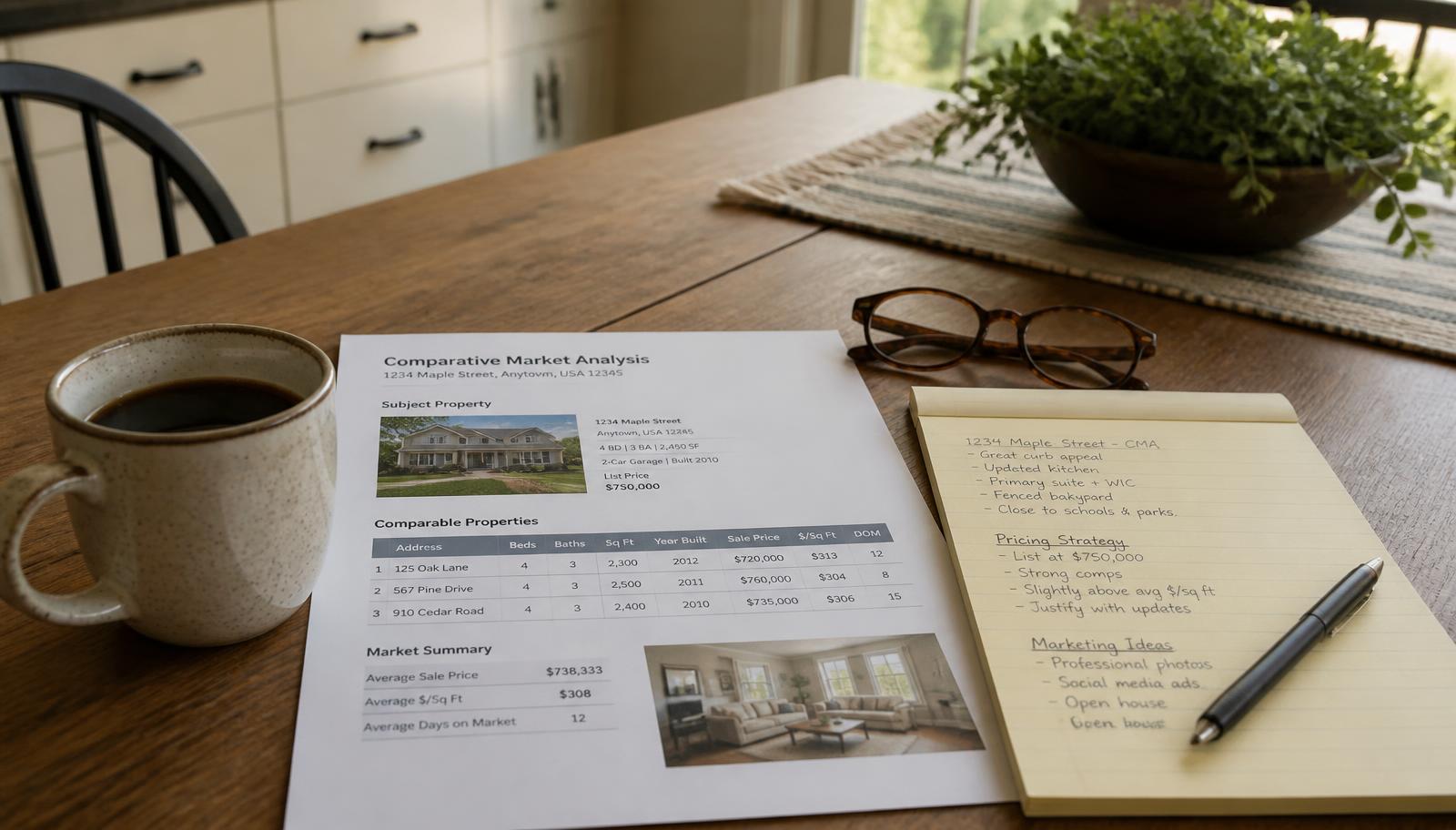
A real home valuation is built from three things: verified comparable sales of genuinely similar homes, an honest assessment of your home's condition and functional layout, and current market timing, meaning what buyers are actually paying and how fast they're paying it right now. An online estimate uses public data and averages. A defensible valuation uses the specific facts of your property and can be explained line by line to anyone who asks.
This article covers the real estate side of valuation only. It is not legal, tax, or appraisal advice.
Almost every conversation I have about selling starts with the same question, phrased a dozen different ways: what is this home actually worth?
It's a fair question, and it deserves a better answer than a number pulled off a website. Especially when the number isn't just for you. When an estate is being settled, when two people are dividing assets, or when siblings are deciding whether to sell or keep a family home, that number has to hold up to scrutiny from people who weren't in the room when it was created.
Why "what did the neighbor's house sell for" isn't a real valuation
The house down the street is a data point, not a valuation. It tells you something, but rarely what people assume it tells them.
Two homes on the same block can be separated by fifty thousand dollars or more for reasons that never show up in a sale price headline:
- Finished square footage and where it sits. Below-grade finished space rarely carries the same value per square foot as above-grade space, and buyers price it differently.
- Layout and function. A fourth bedroom on the main level is worth more to a buyer than a fourth bedroom tucked behind a furnace room, even though both count as a bedroom.
- Condition and updates. A kitchen refreshed three years ago and a kitchen original to 1978 are not the same house, no matter how similar the exterior looks.
- Lot and setting. Corner lots, walkout basements, highway noise, mature trees, and usable yard space all move the number.
- Terms of the sale. A price that included seller-paid closing costs, a rent-back, or a cash offer on a short timeline is not the same as the number recorded on paper.
- Timing. A sale that closed in March reflects a market that may not exist in September.
Online estimates have the same problem at scale. They're built from public records and broad averages, and they cannot see the inside of your home. They don't know the roof was replaced last year, or that the lower level floods, or that the primary bathroom hasn't been touched in forty years. Sometimes they land close. Sometimes they're off by six figures. The trouble is you have no way of knowing which one you're looking at.
What matters more during a transition
When a home is being sold as part of a larger transition, an estate, a divorce, a move to assisted living, the valuation carries more weight than it does in a routine sale. Other people are relying on it, and it often needs to survive a conversation with an attorney, a sibling, a judge, or an accountant.
A few factors tend to matter more in these situations than they would otherwise:
- Deferred maintenance. Homes that have been lived in for decades, or that sat vacant for a stretch, often carry a list: roof, furnace, siding, plumbing, or foundation work. Buyers price that risk conservatively, and a valuation that ignores it will not survive an inspection.
- Dated finishes. Original kitchens, bathrooms, carpet, and paint are not a flaw. They are a discount. The honest question is whether the discount is smaller or larger than the cost of fixing it.
- Occupancy status. Vacant, tenant-occupied, and owner-occupied homes each present differently to buyers and each affect showing access, condition, and timeline.
- Personal property still in the home. A full house of belongings makes it harder for buyers to see the space and harder for anyone to assess condition accurately.
- Timeline pressure. A sale that has to close by a certain date is a different pricing conversation than one with no deadline. Pretending otherwise helps no one.
This is what I mean when I say the number has to hold up to scrutiny. It isn't enough to have a figure. You need to be able to show where it came from, which sales support it, what was adjusted and why, and what would change it. When multiple parties are relying on the same number, that transparency is what keeps the process from turning adversarial.
How appraisals differ from an agent's market valuation
These two things get used interchangeably, and they are not the same tool.
| Agent market valuation | Licensed appraisal | |
|---|---|---|
| Who prepares it | A licensed real estate agent or broker | A state-licensed or certified appraiser |
| What it answers | What buyers are likely to pay right now, and how to position the home to get there | An independent opinion of value as of a specific date |
| Typical use | Deciding whether, when, and at what price to sell | Lender financing, estate and tax filings, court proceedings, some settlements |
| Cost | Usually provided at no cost as part of a listing conversation | A paid engagement, typically several hundred dollars |
| Formality | Detailed and defensible, but not a formal legal document | A formal report intended to stand up in legal and lending contexts |
In practice: if you're deciding what to do with a property, an agent valuation is usually the right first step, and often the only one you need. If a court, a lender, the IRS, or an estate filing requires a formal opinion of value, particularly a date-of-death value for an inherited property, you need a licensed appraiser. Your attorney or accountant is the right person to tell you which one your situation requires.
The two frequently work together. I've walked plenty of properties where the family needed an appraisal for the estate and a market valuation to decide whether to sell, rent, or hold. Different questions, different tools, no conflict between them.
What a valuation from me actually looks like, step by step
- A conversation first. Before I look at a single comparable sale, I want to understand the situation. Who's involved, what the timeline looks like, whether the goal is the highest price, the fastest close, or the least disruption. Those goals lead to different recommendations.
- A walkthrough of the property. In person, room by room. I'm looking at condition, layout, systems, deferred maintenance, and the things buyers notice in the first ninety seconds. This is the part no online tool can do.
- Comparable sales research. Recent closed sales of genuinely similar homes, with adjustments for square footage, condition, layout, lot, and terms. I also look at what's currently active and what didn't sell, because your competition matters as much as the closed sales.
- Market timing. Days on market, absorption, price reductions, and buyer behavior in your specific price band and area right now, not the market from six months ago.
- A range, not a single number, with the reasoning shown. You get a supported range, the sales behind it, and a plain explanation of what would move the number up or down, including what updates are worth doing and what to skip.
- Options, not a pitch. Sell now, sell later, sell as-is, sell after targeted work, rent, or hold. If selling isn't the right move for you right now, I'll say so.
There's no obligation attached to any of this, and no expectation that you decide anything at the end of it. Plenty of people I've walked homes with didn't sell that year, or at all. The point is that you make the decision with real information instead of a guess.
If you're trying to understand what a property is worth, whether it's your own home, an inherited property, or a home being sold as part of a divorce, I'm glad to walk it with you and give you an honest read. Call or text me at 612-247-7593, or email jason.lange@remax.net.
- Inherited a property in Minnesota? Start here
- Selling a home during a divorce in Minnesota
- Probate and the real estate timeline in Minnesota
- Working with attorneys and family members when selling an inherited home
- Sell an inherited house as-is or fix it up first?
- Which home improvements actually pay off before you sell
This article is general information about how real estate valuations work. It is not legal, tax, or appraisal advice. For questions about probate, estate filings, property division, or the tax treatment of a sale, please consult a qualified attorney or accountant.
Frequently Asked Questions
Is an online estimate accurate enough to make a decision?
+
It's a starting point, not a decision-making tool. Online estimates are built from public records and broad averages and cannot see condition, layout, updates, or deferred maintenance. They're sometimes close and sometimes off by a wide margin, and you have no way of knowing which from the outside.
Do I need an appraisal, or is an agent valuation enough?
+
If you're deciding whether and when to sell, an agent market valuation is usually enough. If a lender, court, estate filing, or tax matter requires a formal opinion of value, including a date-of-death value on an inherited home, you need a licensed appraiser. Your attorney or accountant can confirm which your situation requires.
Does a valuation cost anything?
+
A market valuation as part of a listing conversation is provided at no cost and with no obligation. A formal licensed appraisal is a paid engagement, typically several hundred dollars depending on the property.
Should we clean out or update the home before getting it valued?
+
No. It's better for me to see the property as it is. Part of the work is telling you which updates would meaningfully change the number and which would just cost you money and time. Valuing it first keeps you from spending on the wrong things.
Will the same valuation work if several family members or attorneys need to review it?
+
That's exactly how it should be built. You get a supported range, the comparable sales behind it, and the reasoning for each adjustment, so anyone reviewing it can follow how the number was reached rather than being asked to take it on faith.
About the Author
Written by Jason Lange
Jason Lange is a licensed REALTOR® with RE/MAX Results who has helped homeowners throughout Minnesota and Western Wisconsin value and sell homes since 2004, including estates, divorce sales, and properties held in families for decades.
More about Jason →